Wisconsin Estate Accounting: A Representative's Guide
Wisconsin probate runs through the circuit court in each county, and its fiduciary is the personal representative. Wisconsin mandates two statewide court forms wherever either is used: PR-1811, the inventory, and PR-1814, the estate account. Here is what each covers, the deadlines behind each, and how a Wisconsin estate closes.
Section 1 of 7.The two documents: PR-1811 and PR-1814
Wisconsin administers estates under chapters 851 to 879 of the Wisconsin Statutes, through the circuit court in each county. The statute calls the fiduciary the personal representative throughout, whether appointed under a will or without one; this guide uses the same term (some call the role the executor or administrator instead). Wisconsin runs two tracks, not the supervised-versus-independent split some other states use: formal administration, a circuit court proceeding under a judge's continuous supervision (chapters 856, 858, 862, 863), and informal administration, handled by a probate registrar rather than a judge for routine matters, though it remains a circuit court proceeding in every other respect (Wis. Stat. § 865.01).
PR-1811, Inventory (Informal Administration and Formal Administration), and PR-1814, Estate Account (Informal Administration and Formal Administration), are the two statewide circuit court forms the Wisconsin court system requires under Wis. Stat. § 758.18 and SCR 70.153. Both carry the same footer sentence, verbatim: "This form shall not be modified. It may be supplemented with additional material." Once either form is used, using this mandatory version of it is not optional, and a personal representative may not retype or reshape it. The current revision of both is 05/24.
When each reaches the court differs by track. In formal administration, the personal representative must file PR-1811 within a reasonable time, no later than six months after appointment (Wis. Stat. § 858.01), and must file a verified PR-1814 whenever petitioning for final settlement, resigning, being removed, or when the court directs it (Wis. Stat. § 862.01). In informal administration, the personal representative furnishes a copy of the inventory to interested persons and only exhibits it, without filing, to the probate registrar (Wis. Stat. § 865.11(2)); the estate account need not be filed with the court at all, though it must exist and be given in writing to distributees before the estate can close (Wis. Stat. § 865.16(1)(b)). In practice, every closing checklist we found still treats filing the inventory, with its statutory fee, as standard even under the informal track's narrower "exhibit, need not file" language.
Because PR-1811 and PR-1814 are mandatory forms that by law cannot be modified, no software, including ExecutorLedger, can generate a document a personal representative signs or files in their place. What follows describes the figures each form asks for, and how ExecutorLedger's own preparation aid, built to the same shape, helps a personal representative gather them before transferring them onto the court's own PR-1811 and PR-1814.
Section 2 of 7.Wisconsin deadlines, with the statute behind each
- Day 15 (about 2 weeks)Publish notice of the claims deadline to creditors
Why
Under Wis. Stat. §859.07(1), the personal representative generally must publish notice of the creditors' claims deadline (class 3 notice under §879.05(4)), with the first newspaper insertion within 15 days of the date of the §859.01 order (an order that issues when the application for administration is filed, typically at or just before appointment), so this entry anchors to appointment; confirm the actual order date and publication deadline with your attorney. - Day 60 (about 2 months)Notice to Department of Health Services (Medicaid/institutional care)
Why
Under Wis. Stat. §859.07(2), if the decedent (or spouse) received Medicaid or long-term-care benefits, or was a patient or inmate at a state or county institution, the personal representative generally must mail notice to the Department of Health Services (or the Department of Children and Families or Corrections, as applicable) by registered or certified mail at least 30 days before the claims deadline; this entry assumes the earliest possible claims deadline (3 months after the order), so confirm whether this applies to your decedent and the exact mailing deadline with your attorney. - Day 120 (about 4 months)Creditors' claims-filing deadline
Why
Under Wis. Stat. §859.01, when the application for administration is filed (typically at or just before appointment), the court or probate registrar generally enters an order setting the creditors' claims deadline at 3 to 4 months after the date of that order, and §859.02 bars most unfiled claims after that date (with exceptions, e.g. certain tax, funeral, and administration claims); this entry uses the latest possible date (4 months), so confirm the operative bar date with your attorney before paying claims or distributing. - Day 180 (about 6 months)File inventory with the court (formal administration)
Why
Under Wis. Stat. §858.01, in formal administration, the personal representative generally must file the inventory within a reasonable time and no later than 6 months after appointment (the court can extend or shorten this by order); in informal administration, §865.11(2) only requires furnishing the inventory to interested persons and exhibiting it to the probate registrar, not filing it; confirm which track your estate is on and the exact filing requirement with your attorney. - Day 540 (about 18 months)Close the estate or show cause why it remains open
Why
Under Wis. Stat. §863.35, if the estate is not closed within 18 months after the petition for administration was filed (final judgment in formal administration under sub. (1); the closing sworn statement in informal administration under sub. (2)) and no order has extended the time, the judge or probate registrar generally orders the personal representative to show cause why it hasn't closed; the petition is filed at or shortly before appointment, so the true 18-month mark may fall slightly earlier than this date. Confirm your estate's filing date and current status with your attorney.
- Day 270 (about 9 months)Federal estate tax return (Form 706), if required
Why
Under IRC §6075, Form 706 is due 9 months after death, but only if the gross estate exceeds the federal exemption or the estate elects portability, and a 6-month extension may be available; confirm applicability and timing with your attorney.
Formal administration files the inventory within a reasonable time, no later than six months after appointment, unless the court extends or shortens that time by order (Wis. Stat. § 858.01). Informal administration has no fixed statutory deadline for the inventory, only the duty to furnish a copy to interested persons and exhibit it to the probate registrar (Wis. Stat. § 865.11). Whichever document sets the net value of the property subject to administration carries its own statutory fee under Wis. Stat. § 814.66: as of today, $20 if that net value is $10,000 or less, otherwise 0.2 percent of the net value, due at the time of filing. A pending amendment raises the threshold to $18,500 and the flat fee to $36 effective November 1, 2026; the 0.2 percent marginal rate is unchanged either way.
Read the full explanation
For creditors, notice of the claims deadline is published within 15 days of the date of the court's or registrar's order setting that deadline (Wis. Stat. § 859.07(1)). The order itself sets the deadline at not less than three nor more than four months from its own date (Wis. Stat. § 859.01), and most claims not filed by then are barred, with exceptions for tort claims, certain marital-property claims, Wisconsin tax and unemployment-insurance claims, funeral and administration expenses, and some state or federal claims (Wis. Stat. § 859.02). If the decedent or a surviving spouse was institutionalized, owed a state or county obligation, or received Medicaid or long-term-care benefits, the personal representative must also mail notice to the Department of Health Services (or Children and Families, or Corrections, as applicable) and the county clerk, by registered or certified mail, at least 30 days before the claims deadline (Wis. Stat. § 859.07(2)).
Formal administration files a verified account whenever the personal representative petitions for final settlement, is removed, resigns, or the court directs it (Wis. Stat. § 862.01). Informal administration closes instead by filing a sworn statement, PR-1816, with the probate registrar once notice and the claims period are complete and a full written account has reached distributees (Wis. Stat. § 865.16). Either way, if the estate is not closed within 18 months after the petition for administration was filed, and no order has extended the time, the judge or probate registrar orders the personal representative to show cause why it remains open (Wis. Stat. § 863.35).
A federal estate tax return, Form 706, if the estate needs one, is due nine months after death (IRC section 6075), with a possible six-month extension. Confirm whether the estate needs one with your attorney.
Section 3 of 7.What Wisconsin pays a personal representative
Wis. Stat. § 857.05(2) allows the personal representative commissions computed on the inventory value of the property the personal representative is accountable for, minus any mortgages or liens on it, plus net principal gains the estate realizes during administration, at a rate of 2 percent, or at whatever rate the decedent and the personal representative, or the persons who receive the majority interest in the estate and the personal representative, agree to in writing. The base is net principal, or capital, gains realized in the estate proceedings, not ordinary income such as dividends, interest, or rent. Subject to the court's approval, further sums may be allowed in cases of unusual difficulty or extraordinary services.
If a personal representative is derelict in duty, the court may reduce or deny that compensation (Wis. Stat. § 857.05(2)). If the personal representative, or a law firm the personal representative is associated with, also serves as the estate's attorney, the court may allow either the personal representative's commissions or attorney fees, and must allow both if the decedent's will authorizes it (Wis. Stat. § 857.05(3)).
Section 4 of 7.How a Wisconsin estate closes
Once every claim, funeral cost, tax, and administration expense is paid or accounted for and the assets are inventoried and distributed, an informal estate closes by filing a verified statement, PR-1816, with the probate registrar (Wis. Stat. § 865.16). The statement certifies that notice reached interested persons and creditors, the claims deadline has passed, the estate is fully administered, and a copy of the statement plus a full written account has gone to distributees and to any creditor whose claim remains unpaid and unbarred. Personal representatives typically collect a signed receipt from each distributee (PR-1815, Estate Receipt) before filing. If no proceeding challenging the statement is pending six months after it is filed, the personal representative's appointment terminates automatically (Wis. Stat. § 865.16(2)); the personal representative may, but need not, also meet chapter 862's formal accounting requirements.
A formal estate closes instead by filing the final account and petitioning the court for a hearing and a final judgment assigning the estate to the persons entitled to it (Wis. Stat. § 863.25). Within 120 days after the final judgment is signed, the personal representative files receipts from the distributees for the property assigned (Wis. Stat. § 863.41), and the court then enters an order discharging the personal representative and canceling the bond (Wis. Stat. § 863.47).
- Once the creditors' claims deadline passes and you've paid every valid claim, funeral cost, tax, and administration expense, prepare a full written account and file a verified (sworn) closing statement with the circuit court's probate registrar (Wis. Stat. §865.16). This is the standard way to end an informally administered Wisconsin estate without a judge's hearing.
- Send a copy of that closing statement and the full written account to every distributee and to any creditor whose claim is still unpaid or unresolved, then collect the distributees' signed receipts and file them with the probate registrar (Wis. Stat. §865.21, following the 120-day timing in §863.41).
- If the estate is under formal (judge-supervised) administration, or a dispute makes the informal route impractical, file a final account and petition the circuit court for a final judgment assigning the estate instead (Wis. Stat. §863.25), file the distributees' receipts within 120 days after the final judgment is signed (§863.41), and request an order of discharge (Wis. Stat. §863.47).
- Keep your records after filing: if no proceedings challenging the closing statement (or otherwise involving you) are pending 6 months after it's filed, your appointment as personal representative automatically terminates (Wis. Stat. §865.16(2)).
Wisconsin probate matters are handled by the circuit court (probate division); day-to-day informal administration is run by a probate registrar rather than a judge.
Section 5 of 7.PR-1811 and PR-1814 explained for a first-time personal representative
PR-1811's page 2 is a single flat numbered schedule, not split into real-property and personal-property sections the way some states' inventories are. Its three columns, verbatim: Number; Supporting Inventory Schedules (description of property, including digital property, legal description of real estate, and related encumbrances, liens or other charges against each item, with marital property clearly designated); and Value of Decedent's Interest on Date of Death. Page 1 rolls that schedule into three summary lines: the total value of property subject to administration, minus the total value of encumbrances, liens, or other charges, leaving the Net Value of Property Subject to Administration, which cannot go below $0. That floor applies item by item too: if a single asset's lien exceeds its own value, only the asset's own value is deducted, never the full loan balance.
Marital property gets a specific treatment: each spouse owns one half of marital property regardless of whose name is on the title, so a jointly owned item is disclosed at its full value but entered in the value column at only the decedent's one-half interest, shown parenthetically, for example "$700,000.00 x 1/2 = $350,000.00."
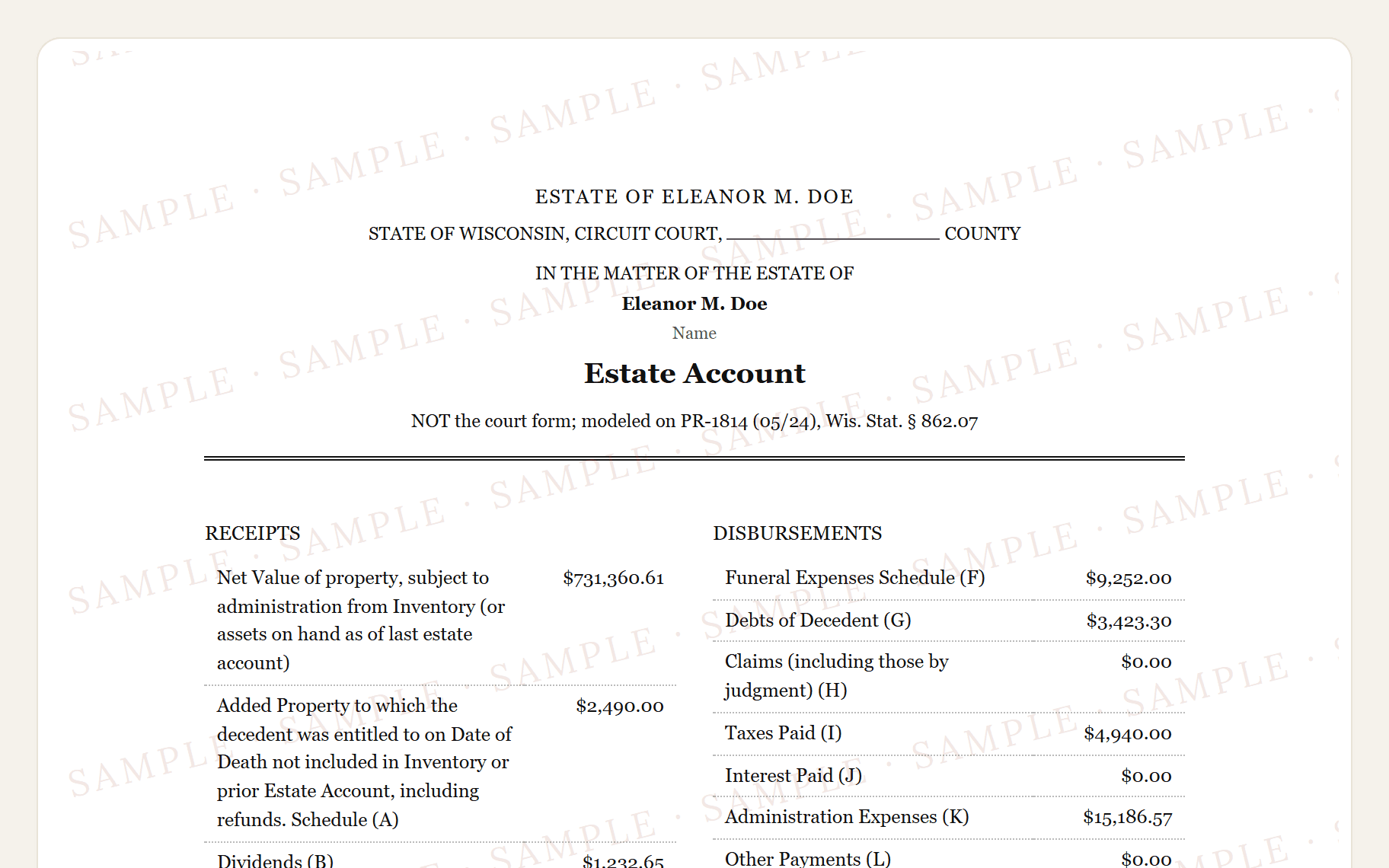
PR-1814's summary table runs two sides that must tie. RECEIPTS opens with the net value carried from the inventory (or, after the first account, the prior account's own ending balance), then Schedules A through E: added property and refunds, dividends, interest, capital gains and losses combined, and other receipts, to a TOTAL. DISBURSEMENTS lists Schedules F through M: funeral expenses, debts of the decedent, claims, taxes paid, interest paid, administration expenses, other payments, and distributions paid to date, to a TOTAL DISBURSEMENTS, then adds Assets on Hand, Schedule N, to a second TOTAL. The form's own boxed instruction says it plainly: totals in each column must be the same, meaning the receipts total has to equal disbursements plus what remains on hand.
Schedule D is the one place Wisconsin differs from many other states' accounts: every sale's gain or loss posts to this single schedule, not split into separate gain and loss schedules. Each sale gets its own line, individually labeled a capital gain or a capital loss, and the schedule nets to one total that can itself be negative.
Distributions are tracked by distributee, not by asset. Schedule M lists cumulative distributions paid to date; Schedule O, a separate line, is the proposed distribution of whatever remains, and should equal Schedule N, the assets still on hand. Property distributed in kind carries at its inventory value, or, for property found after the inventory, at its acquisition value, never a value re-set to the date of distribution (Wis. Stat. § 862.07). Page 3 gathers every schedule's own detail lines, in schedule-letter order, into one table.
Section 6 of 7.Where ExecutorLedger fits
Recording is free for as long as the estate takes: every receipt and disbursement with its date and description, distributions per beneficiary, and a balance that checks itself as you go. ExecutorLedger builds Wisconsin-style documents from those records, an inventory shaped like PR-1811 and an account shaped like PR-1814, ready to transcribe onto the court's own unmodified forms when you file or furnish them. Neither is a court form, and your attorney should review them before anything is signed or filed. Every document previews free with your real numbers, and $149 once per estate lifts the watermark.
Section 7 of 7.Questions Wisconsin executors ask
Does Wisconsin require the PR-1811 inventory and PR-1814 estate account?
Both are mandatory statewide forms under Wis. Stat. § 758.18 and SCR 70.153, each marked "This form shall not be modified." Whether either is filed with the court depends on the administration track: informal administration only requires furnishing PR-1811 to interested persons and exhibiting it to the probate registrar (§ 865.11(2)), and an informal estate can close without ever filing PR-1814 with the court, since the closing statement, PR-1816, is what gets filed (§ 865.16). Formal administration files both.
When is the Wisconsin inventory due?
In formal administration, no later than six months after appointment (Wis. Stat. § 858.01). In informal administration, there is no fixed statutory deadline, only a duty to furnish a copy to interested persons and exhibit it to the probate registrar (§ 865.11). Either way, a statutory filing fee under § 814.66 accompanies it: currently $20 if the net value is $10,000 or less, otherwise 0.2 percent of the net value.
How is a Wisconsin personal representative paid?
Wis. Stat. § 857.05(2) allows commissions of 2 percent of the inventory value the personal representative is accountable for, minus mortgages or liens, plus net principal gains realized during administration, or a different rate agreed to in writing. The court can allow more for unusual difficulty or extraordinary services, and can reduce or deny compensation if the personal representative is derelict in duty.
How does a Wisconsin estate close?
Most informal estates close by filing a verified statement, PR-1816, with the probate registrar once notice and the claims period are complete and a full written account has reached distributees (Wis. Stat. § 865.16). Formal estates close instead by filing a final account, petitioning for a hearing and a final judgment assigning the estate (§ 863.25), then filing distributee receipts within 120 days so the court can discharge the personal representative (§§ 863.41, 863.47).
What is the difference between formal and informal administration in Wisconsin?
Informal administration is handled by a probate registrar rather than a judge for routine matters, under chapter 865, and typically closes by a sworn statement rather than a court hearing. Formal administration is a circuit court proceeding under a judge's continuous supervision, under chapters 856, 858, 862, and 863, and closes with a filed final account and a final judgment. Both tracks use the same PR-1811 and PR-1814 forms.
Not sure which accounting your situation calls for? Which accounting do I need? covers the choice, and the accounting guide explains the structure every format shares.
This page describes Wisconsin practice as our verified references state it; formats drift and estates differ, and none of this is legal advice. ExecutorLedger produces court-style documents for transcription. They are not official court forms. The accounting your estate needs is a question for its attorney.