Louisiana Succession Accounting: A Representative's Guide
Louisiana calls its probate proceeding a succession, and it prescribes no statewide or parish form for either document a succession representative prepares. Here is what the sworn detailed descriptive list and the account of the succession representative cover, and when the law requires filing one.
Section 1 of 7.The two documents: the sworn detailed descriptive list and the account
Louisiana calls its probate proceeding a succession, and its fiduciary a succession representative, whether the court names an executor under a will or an administrator when there is none. Louisiana has no separate probate court; the district court of the parish where the decedent was domiciled handles the succession, and in Orleans Parish that is the Civil District Court. Louisiana prescribes no statewide or parish form for either document. Two documents carry the work instead: the sworn detailed descriptive list, and the account of the succession representative.
The sworn detailed descriptive list (La. C.C.P. art. 3136) is filed in lieu of a formal notarial inventory, and it can be filed without judicial authority. It is sworn and subscribed by the person filing it, shows the location of every item of succession property, and sets the fair market value of each item at the date of death. It carries two value columns: Total Value, the date-of-death figure, and Decedent's Interest, the customary figure for the decedent's own share, which is all of the separate property plus one-half of the community property. The registry does not classify any asset as community or separate property, so that column is left for you to complete by hand. Under art. 3137, the list stands as prima facie proof of what it shows unless amended or successfully traversed; if it is amended or traversed, a copy of the corrected list goes to the Department of Revenue.
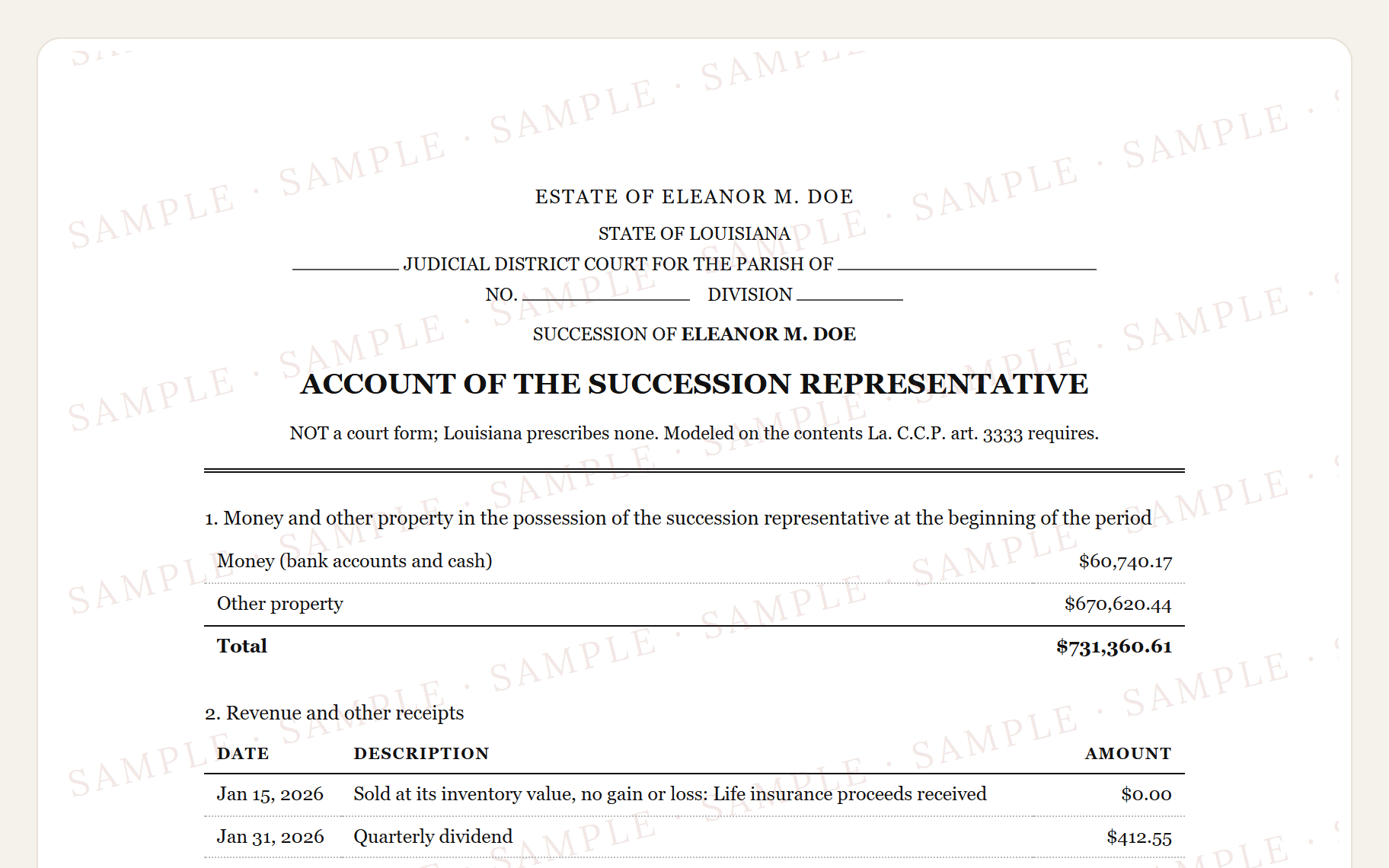
The account of the succession representative (arts. 3331 through 3337) follows what art. 3333 requires: money and property on hand at the start of the period, revenue and other receipts, disbursements and the disposition of property, and what remains on hand at the end. In an independent administration (arts. 3396.17 through 3396.19), no interim account is required unless an interested person demands one, and the heirs and legatees can waive a final account entirely.
Section 2 of 7.Louisiana deadlines, with the statute behind each
- Day 30 (about 1 month)Inventory or sworn detailed descriptive list
Why
Under La. C.C.P. arts. 3136 & 3396.18, Louisiana generally requires an inventory or a sworn detailed descriptive list of succession property (locations and date-of-death fair market values) but sets no fixed day count, so this 30-day marker is anchored to your appointment only as a conservative reminder; the list is typically filed with the opening pleadings or promptly after qualification, and it must be on file before the succession can be closed; confirm the timing with your attorney. - Day 365 (about 1 year)Annual account of administration
Why
Under La. C.C.P. art. 3331, a succession representative in an ordinary administration generally must file an account annually (and at any other time the court orders one, on its own motion or on an interested person's application), while an independent administrator typically accounts only when an interested person demands it under art. 3396.17; confirm whether an annual account applies to your administration with your attorney.
- Day 270 (about 9 months)Federal estate tax return (Form 706), if required
Why
Under IRC §6075, Form 706 is due 9 months after death, but only if the gross estate exceeds the federal exemption or the estate elects portability, and a 6-month extension may be available; confirm applicability and timing with your attorney.
The descriptive list carries no fixed statutory day count (arts. 3136, 3396.18). It has to be on file, sworn, before the court can render a judgment of possession or discharge the succession representative. ExecutorLedger seeds a 30-day reminder from your appointment as a conservative marker, not a deadline the statute itself sets.
Read the full explanation
An annual account is due every year in an ordinary administration, and at any other time the court orders one (art. 3331). In an independent administration, no account is due until an interested person demands one (art. 3396.17).
A final account is due before discharge: art. 3332 in an ordinary administration, art. 3396.19 in an independent administration, where the heirs and legatees can waive it instead.
The federal estate tax return, Form 706, if the succession needs one, is due 9 months after death (IRC §6075), with a possible 6-month extension. Confirm whether your succession needs one with your attorney.
Section 3 of 7.What Louisiana pays a succession representative
Art. 3351 sets the default: 2.5% of the amount of the inventory or the descriptive list, unless the testament or an agreement with the heirs sets a different figure. It is due on homologation (court approval) of the final account, and advances are allowed during administration.
Section 4 of 7.How a Louisiana succession closes
Many simple Louisiana successions skip administration entirely and go straight to an ex parte judgment of possession (art. 3061), sending the heirs and legatees into possession without ever filing a descriptive list or an account.
An administered succession follows four steps instead: the sworn detailed descriptive list on file (arts. 3136, 3396.18); the final account homologated after notice, or, in an independent administration, waived by the heirs and legatees (art. 3396.19); a judgment of possession (art. 3381), the order that puts the heirs and legatees in possession and transfers title; and discharge (art. 3391), once the court sees that creditors were paid and the property delivered.
Independent administration lets the succession representative administer with less court supervision along the way, but it closes through the same last two steps: a judgment of possession, then discharge.
- Make sure a sworn detailed descriptive list (or formal inventory) of the estate is on file. The court will not render a judgment of possession or discharge you without one (La. C.C.P. arts. 3136, 3396.18).
- In an independent administration, the heirs and legatees can waive the final accounting (La. C.C.P. art. 3396.19). Otherwise file a final account with the court and have it homologated (court-approved) after notice to each heir and residuary legatee (La. C.C.P. arts. 3332, 3335).
- Petition the district court for a judgment of possession, the order that puts the heirs and legatees in possession of the property and transfers title to them (La. C.C.P. arts. 3061, 3381).
- Distribute what remains, keep signed receipts, and petition for discharge; once the court sees that creditors were paid and the property was delivered, it renders a judgment discharging you and canceling your bond (La. C.C.P. art. 3391).
Louisiana has no separate probate court: the district court of the parish where the deceased was domiciled handles the succession (in Orleans Parish, the Civil District Court). Many simple Louisiana estates skip administration entirely and go straight to an ex parte judgment of possession, and independent administration (La. C.C.P. art. 3396 et seq.) lets an executor administer with minimal court supervision before closing the same way.
Section 5 of 7.The documents explained for a first-time succession representative
Immovable property (real estate) on the descriptive list needs a full legal description, not a street address; a street address alone leaves a cloud over the title. Art. 3136 also requires the location of every item, movable or immovable.
The registry does not classify any asset as community or separate property, and it does not track what the decedent owed at death, only what the succession has paid. That is why the list's Decedent's Interest column, and its Debts section, are yours to complete by hand.
Art. 3333 lays the account out in four parts: money and property on hand at the start of the period, revenue and other receipts, disbursements and the disposition of property, and what remains on hand at the end. A sale during the period moves the account by its gain or loss against the value the asset was carried at: a gain is a receipt, a loss a disbursement, and a sale at its carried value still gets its own zero-dollar line, so the record shows the sale happened.
Before homologation, the account goes to every heir and residuary legatee with ten days' notice; a final account needs the more formal service art. 1314 describes, or certified mail (art. 3335). Any interested person may oppose it before homologation (art. 3336). Once homologated, a final account has the effect of a final judgment; an interim account is only prima facie proof of what it shows (art. 3337).
Section 6 of 7.Where ExecutorLedger fits
Recording is free for as long as the succession takes: every receipt and disbursement with its date and description, distributions per heir or legatee, and a balance that checks itself as you go. ExecutorLedger builds Louisiana-style documents from those records, a sworn detailed descriptive list and an account of the succession representative, ready to transcribe if you end up filing them or handing a copy to the heirs and legatees. Neither is a court form, and your attorney should review them before anything is signed or filed. Every document previews free with your real numbers, and $149 once per estate lifts the watermark.
Section 7 of 7.Questions Louisiana executors ask
Is there a court form for Louisiana's sworn detailed descriptive list?
No. Louisiana prescribes no statewide or parish form for either document (La. C.C.P. art. 3136). The list follows the shape Louisiana practice commonly uses: sworn, and filed without judicial authority, showing the location and date-of-death value of every item.
When is the Louisiana descriptive list due?
Art. 3136 sets no fixed day count. It has to be on file, sworn, before the court can render a judgment of possession or discharge the succession representative (arts. 3136, 3396.18).
Does the account have to be filed with the court?
An account is due every year in an ordinary administration (art. 3331), and a final account is due before discharge (art. 3332). In an independent administration, no account is due until an interested person demands one (art. 3396.17), and the heirs and legatees can waive the final account (art. 3396.19).
How is a Louisiana succession representative paid?
Art. 3351 sets 2.5% of the amount of the inventory or descriptive list as the default, unless the testament or an agreement with the heirs sets a different figure. It is due on homologation of the final account, and advances are allowed during administration.
How does a Louisiana succession close?
Many simple successions go straight to an ex parte judgment of possession (art. 3061). An administered succession needs the descriptive list on file, the final account homologated or, in an independent administration, waived (art. 3396.19), a judgment of possession (art. 3381), and discharge (art. 3391).
Not sure which accounting your situation calls for? Which accounting do I need? covers the choice, and the accounting guide explains the structure every format shares.
This page describes Louisiana practice as our verified references state it; formats drift and estates differ, and none of this is legal advice. ExecutorLedger produces court-style documents for transcription. They are not official court forms. The accounting your estate needs is a question for its attorney.