Illinois Estate Accounting: A Representative's Guide
Illinois has no statewide probate form for either document. Cook County prescribes the CCP 0334 inventory, and Circuit Court Rule 12.13 names the five sections a Cook County account must have. Here is what each covers, when Illinois law requires filing one, and how an estate closes.
Section 1 of 7.The two documents: the CCP 0334 inventory and the Rule 12.13 account
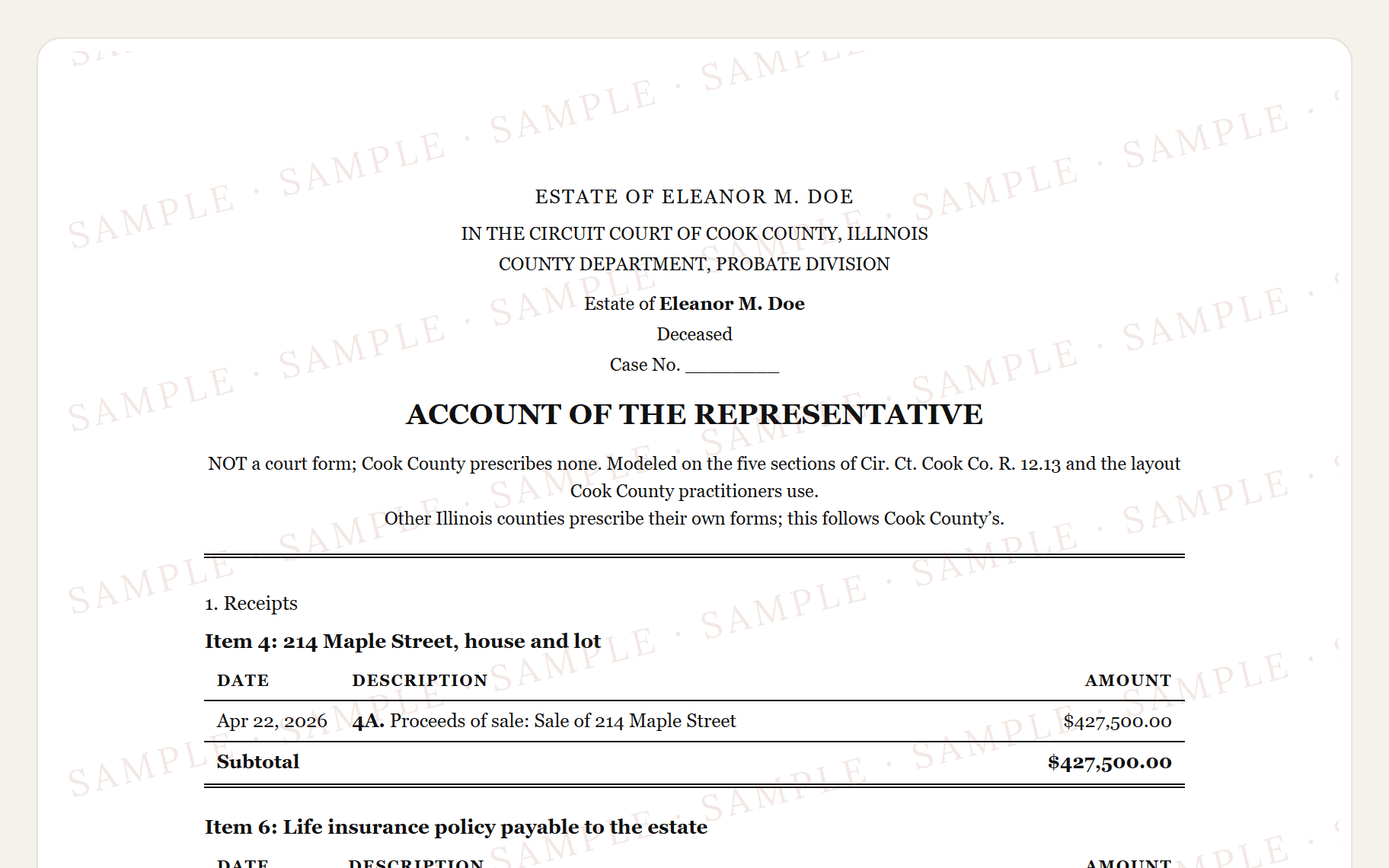
Illinois administers estates under the Probate Act of 1975 (755 ILCS 5), but the Illinois Supreme Court's statewide approved-forms list carries no probate, inventory, or account form of any kind. Cook County is the only county checked here with a numbered inventory form: CCP 0334, Inventory (Rev. 12/01/24), a one-page prescribed form from the Clerk of the Circuit Court of Cook County, County Department, Probate Division. For the account, Cook County has no numbered schedule form at all. Circuit Court Rule 12.13 instead names the account's five required sections directly: Receipts, Disbursements, Distributions, Recapitulation, and Assets On Hand at the end of the period of the account. Both documents speak of the representative, the Probate Act's word for the executor or administrator.
Most Illinois estates administer independently, the default track under 755 ILCS 5/28-2, and an independent representative typically files neither document with the court. Instead, 755 ILCS 5/28-6 requires mailing a copy of the inventory to each interested person at least 30 days before filing the final report, and sending a copy to the bond surety by certified mail within 90 days of letters of office. Independent administration closes with a verified final report under 755 ILCS 5/28-11, not with the CCP 0334 inventory or a Rule 12.13 account. Supervised administration is the track that files both with the court: a verified inventory within 60 days of letters (755 ILCS 5/14-1), and a verified account under Rule 12.13 and 755 ILCS 5/24-1.
Cook County's own forms are not a stand-in for the rest of Illinois. Kane County, Lake County, and Will County, among others, prescribe their own local forms and account layouts, different from Cook's and from each other. This guide, and the documents ExecutorLedger builds, follow the Cook County inventory form and rule as a model, since Cook County is the only county checked here with both a numbered inventory form and named account sections to build from. A filing outside Cook County should follow that county's own local rules and forms instead.
Section 2 of 7.The Illinois deadlines, with the statute behind each
- Day 14 (about 2 weeks)Mail notice of probate to heirs and legatees
Why
Under 755 ILCS 5/6-10, the representative generally must mail a copy of the petition and order to every heir and legatee within 14 days after the order admitting the will (or appointing the representative) is entered, with the Supreme Court Rule 108 explanation of their rights, and publish for 3 weeks for any whose address is unknown. This is typically the same day letters issue, which is how this date is anchored. Confirm the exact date and recipient list with your attorney. - Day 14 (about 2 weeks)Publish and mail notice to creditors
Why
Under 755 ILCS 5/18-3, the representative generally must publish a claims notice once a week for 3 successive weeks in a newspaper in the county of administration and mail or deliver notice to every known or reasonably ascertainable creditor; the statute sets no fixed start date, so this reminder is anchored 14 days after letters, but the 6-month claims bar only starts running from first publication, so starting promptly shortens the estate; confirm timing and the creditor list with your attorney. - Day 60 (about 2 months)Inventory due (file with court, or serve if independent)
Why
Under 755 ILCS 5/14-1, in supervised administration the representative generally must file a verified inventory with the court within 60 days after letters issue; an independent representative typically does not file it with the court but instead must send a copy to the bond surety by certified mail within 90 days and to each interested person at least 30 days before filing the final report (755 ILCS 5/28-6); confirm which track applies with your attorney. - Day 180 (about 6 months)Creditor claims bar date
Why
Under 755 ILCS 5/18-3, 18-12, creditor claims are generally barred on the date stated in the notice, which must be at least 6 months from first publication or 3 months from mailing to a known creditor, whichever is later; the clock runs from publication rather than appointment, so this date is anchored to letters as an approximation that typically lands a little early, and any unfiled claim is in any event barred 2 years after death, so calendar the operative bar date before paying or distributing; confirm it with your attorney. - Day 425 (about 14 months)Account to the court / close or report status (~14 months)
Why
Under 755 ILCS 5/24-1, in supervised administration the representative generally must present a verified account of receipts, disbursements, and property on hand within 60 days after the first 12 months from letters (roughly 14 months in) unless the court allows more time or all interested persons consent to excuse it, and courts typically expect independent estates to close or report status on a similar schedule; confirm your court's status date with your attorney.
- Day 270 (about 9 months)Federal estate tax return (Form 706), if required
Why
Under IRC §6075, Form 706 is due 9 months after death, but only if the gross estate exceeds the federal exemption or the estate elects portability, and a 6-month extension may be available; confirm applicability and timing with your attorney. - Day 270 (about 9 months)Illinois estate tax return (Form 700), if required
Why
Under 35 ILCS 405/6, the Illinois estate tax return and payment are generally due when the federal return would be, 9 months after death, and typically apply only if the gross estate exceeds Illinois's $4 million exclusion (35 ILCS 405/2), which is far below the federal exemption; the return is filed with the Illinois Attorney General and tax is paid to the State Treasurer, and extensions may be available; confirm applicability and timing with your attorney.
The inventory is due within 60 days after letters of office issue, in supervised administration (755 ILCS 5/14-1). An independent representative typically does not file it with the court at all: instead, a copy goes to the bond surety by certified mail within 90 days of letters, and to each interested person at least 30 days before filing the final report (755 ILCS 5/28-6).
Read the full explanation
The account is due within 60 days after the first 12 months of letters, roughly 14 months in, unless the court allows more time or every interested person consents in writing to excuse it (755 ILCS 5/24-1; Rule 12.13(b)(i)).
Creditor notice is published for 3 successive weeks and mailed to every known or reasonably ascertainable creditor (755 ILCS 5/18-3). Claims are generally barred the later of 6 months from first publication or 3 months from mailing to a known creditor, and any claim never filed is barred outright 2 years after death (755 ILCS 5/18-3, 5/18-12).
Notice of probate is mailed to every heir and legatee within 14 days of the order admitting the will or appointing the representative, along with the Supreme Court Rule 108 explanation of their rights (755 ILCS 5/6-10).
A federal estate tax return, Form 706, if the estate needs one, is due 9 months after death (IRC section 6075), with a possible 6-month extension. An Illinois estate tax return, Form 700, if the estate needs one, is generally due on the same 9-month schedule, but only when the estate exceeds Illinois's $4 million exclusion, far below the federal exemption (35 ILCS 405/2, 405/6).
Section 3 of 7.What Illinois pays a representative
755 ILCS 5/27-1 sets reasonable compensation for the representative's services, with no statutory percentage schedule and no court-adopted rate table. Illinois courts weigh time spent, the estate's size and complexity, skill and diligence, and results, case by case, so contemporaneous time records matter. Fees rank as first-class administrative claims (755 ILCS 5/18-10). In independent administration, fees are typically approved through interested persons' signed receipts at closing (755 ILCS 5/28-11(b)(9)), with court review only if someone objects.
Section 4 of 7.How an Illinois estate closes
Independent administration, the default and majority track, closes by collecting signed receipts from every interested person approving the inventory, the accounting, and the fees, then filing a verified final report under 755 ILCS 5/28-11 (Cook County's implementing form is CCP 1011). With every receipt on file, the court can discharge the representative and close the estate without a waiting period.
Missing a signature does not stop the filing: mail everyone a copy of the report within 14 days, and wait out the 42-day objection window that runs from filing. If nothing is pending when it expires, the representative is discharged and the estate closes (755 ILCS 5/28-11(e)).
Supervised administration closes differently. The representative presents a verified final account under Rule 12.13 and 755 ILCS 5/24-1 and 5/24-2 for a hearing, with notice, and a copy of the account, given to each person entitled at least 10 days before (Rule 12.13(a)(vii)). The court approves the account, discharges the representative, cancels the bond, and closes the estate. This is the only closing route open to a supervised estate.
- Send each interested person the final accounting and a copy of the inventory, and collect a signed receipt that approves their distribution, the accounting, and your fees. This is independent administration, granted by default and the usual route, unless the will or an objecting interested person requires supervised administration (755 ILCS 5/28-2).
- File a verified final report with the circuit court under 755 ILCS 5/28-11 confirming notices went out, claims and death taxes are handled, expenses are paid, and assets are distributed. With every receipt and approval on file, the court can discharge you and close the estate without a waiting period.
- Missing a signature? File the report anyway, mail everyone a copy within 14 days, and wait out the 42-day objection window that runs from filing. If no objection is pending when it expires, the court discharges you and closes the estate.
- In supervised administration, instead present a verified final account (receipts, disbursements, property on hand) for court approval under 755 ILCS 5/24-1 and ask for an order of discharge.
Probate sits in the circuit court of the county where the decedent lived, with a dedicated probate division in larger counties like Cook. Illinois has no separate surrogate, register of wills, or orphans' court, and no UPC §3-1003 sworn-closing-statement equivalent; the 28-11 verified report fills that role.
Section 5 of 7.The documents explained for a first-time representative
Item numbers travel with the estate. Rule 12.9(c) assigns consecutive Arabic item numbers on the inventory, starting at 1, and carries them forward into the first account. A new item found later gets its own new consecutive number, never a reused one.
Only a bank or cash item on the inventory carries a value, written into the description itself, for example a checking balance. Rule 12.9(c) says a value need not be assigned to any other inventoried item, so the inventory is a flat, two-column list, Item No. and Description, with no Value column at all.
The account has five required sections, named directly by Rule 12.13(a)(i): Receipts, Disbursements, Distributions, Recapitulation, and Assets On Hand at the end of the period of the account. Disbursements are grouped into five categories the rule also names: Administration Expenses, Taxes, Fees, Investment Purchases, and Other Disbursements.
The Recapitulation section reconciles cash: what was on hand at the inventory, plus receipts, less disbursements, less cash distributions, equals what remains on hand, called the current account when more filings will follow and the final account when the estate is done. Assets On Hand values marketable securities at market value and other assets at estimated value, and cross-references back to the Receipts section's item numbers whenever a number changes (Rule 12.13(a)(vi)).
The account carries no oath of its own. Instead, the representative or attorney certifies on a separate voucher certificate that vouchers for every disbursement are on hand, and notice of the hearing, with a copy of the account, goes to every person entitled to it at least 10 days before (Rule 12.13(a)(vii), (b)(ii)).
Section 6 of 7.Where ExecutorLedger fits
Recording is free for as long as the estate takes: every receipt and disbursement with its date and description, distributions per beneficiary, and a cash balance that checks itself as you go. ExecutorLedger builds Illinois-style documents from those records, an inventory shaped like CCP 0334 and an account shaped like Rule 12.13's five sections, ready to transcribe if you end up filing them or handing a copy to interested persons. Neither is a court form, and your attorney should review them before anything is signed or filed. Every document previews free with your real numbers, and $149 once per estate lifts the watermark.
Section 7 of 7.Questions Illinois executors ask
Is there a court form for the Illinois inventory?
Only in Cook County. Cook County prescribes CCP 0334, Inventory (Rev. 12/01/24), but Illinois has no statewide probate form, and other counties, such as Kane, Lake, and Will, prescribe their own local forms.
When is the Illinois inventory due?
Within 60 days after letters of office issue, in supervised administration (755 ILCS 5/14-1). An independent representative typically serves it instead of filing it: a copy to the bond surety within 90 days, and to each interested person at least 30 days before the final report (755 ILCS 5/28-6).
Does the Illinois account have to be filed with the court?
Only in supervised administration, or when the court or an interested person compels one. Independent administration, the default track, closes instead with a verified final report under 755 ILCS 5/28-11.
How is an Illinois representative paid?
755 ILCS 5/27-1 sets reasonable compensation, with no statutory percentage schedule. Fees rank as first-class administrative claims (755 ILCS 5/18-10), and in independent administration are typically approved through interested persons' signed receipts at closing (755 ILCS 5/28-11(b)(9)).
How does an Illinois estate close?
Independent administration closes by collecting signed receipts and filing a verified final report under 755 ILCS 5/28-11, then either discharge with no wait or a 42-day objection window if a receipt is missing. Supervised administration closes with a verified final account under Rule 12.13 and 755 ILCS 5/24-1, approved at a hearing, then an order of discharge.
Not sure which accounting your situation calls for? Which accounting do I need? covers the choice, and the accounting guide explains the structure every format shares.
This page describes Illinois practice as our verified references state it; formats drift and estates differ, and none of this is legal advice. ExecutorLedger produces court-style documents for transcription. They are not official court forms. The accounting your estate needs is a question for its attorney.