South Carolina Estate Accounting: A Representative's Guide
South Carolina probate runs through the probate court in each county, and its fiduciary is the personal representative. Filing the Form 350ES SF inventory and the Form 361ES accounting is not a matter of local habit here: a 2013 South Carolina Supreme Court order mandated both forms statewide, word for word, and the state's own forms catalog still marks them Mandatory today. Here is what each covers, the deadlines behind each, and how a South Carolina estate closes.
Section 1 of 7.The two documents: the Form 350ES SF inventory and the Form 361ES accounting
South Carolina administers decedents' estates under Title 62 of the South Carolina Code, the Probate Code, in the probate court of each county. There is no separate surrogate's court, orphans' court, or register of wills. The statute calls the fiduciary the personal representative throughout, whether appointed under a will or without one (some call the role the executor or administrator instead), and this guide uses the same term. A South Carolina Supreme Court administrative order dated November 18, 2013 named five ES-series forms, including Form 350ES SF and Form 361ES, as mandated statewide: a mandated form has to be reproduced with all the language the court approved, word for word. The state's current forms catalog at sccourts.org still tags both forms Mandatory. That makes South Carolina one of the stricter states this guide covers: a personal representative who files either document with the court has to use the state's own wording, not a paraphrase.
Form 350ES SF, 'Inventory and Appraisement: Probate Property,' is the inventory. South Carolina also publishes a longer version, Form 350ES LF, but county guidance is direct about which one most personal representatives file: York County's self-help sheet says most file the short form, since it covers only the decedent's probate assets. The short form organizes everything into nine lettered schedules, A through I, each rolling up to a single recapitulation on page one: Schedule A Real Estate, B Stocks and Bonds, C Notes Due Decedent and Cash, D Insurance on Decedent's Life Payable to the Estate, E Jointly Owned Property, F Other Miscellaneous Assets, G Transfers During Decedent's Life Payable to the Estate, H Powers of Appointment Payable to the Estate, and I Annuities and Retirement Accounts Payable to the Estate. Schedule E is printed 'N/A' on the short form itself, because jointly owned property with survivorship rights is not a probate asset at all. Filing is due within 90 days after the personal representative's appointment (S.C. Code § 62-3-706), and a copy goes only to an interested person who has demanded one under § 62-3-204, not automatically to every heir. Employing an appraiser is optional, at the personal representative's own discretion.
South Carolina excludes several kinds of property from the inventory altogether, because state law treats them as non-probate assets. Property owned jointly with a right of survivorship passes to the surviving owner outside probate. Life insurance and retirement accounts with a named beneficiary pass directly to that beneficiary, and only the share payable to the estate itself belongs on Schedules D and I. When a personal injury settlement includes a wrongful-death share, that share belongs to the statutory beneficiaries rather than the estate, so only the survival-action portion goes on Schedule C. Out-of-state real property works the other way: it belongs on the inventory along with everything else, since the form's own instructions call for every probate asset regardless of location.
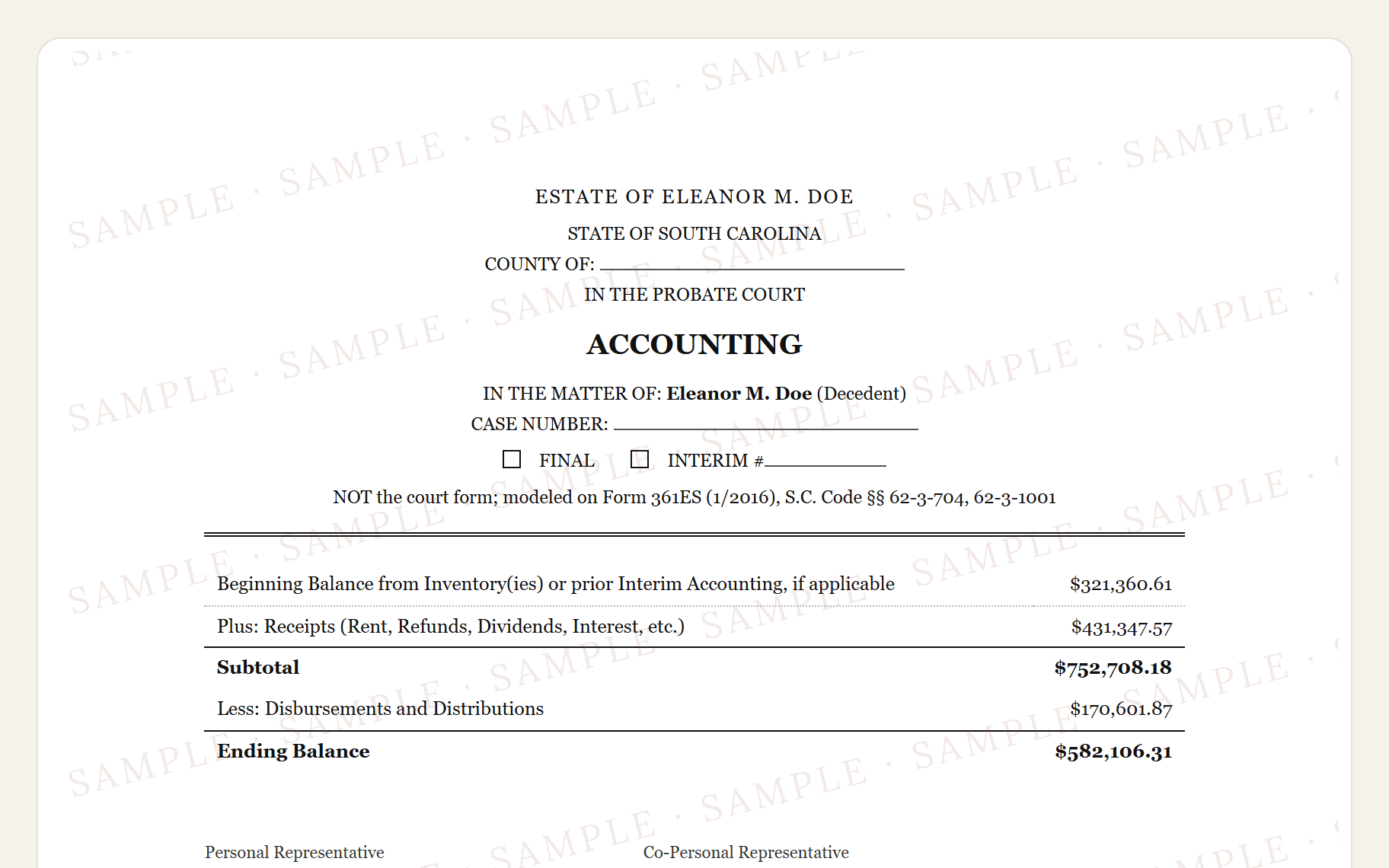
Form 361ES, titled 'Accounting,' is the second mandated form, and it is the only accounting South Carolina asks for by default. There is no separate annual-accounting requirement in the statute, only a final accounting when the estate closes, plus an interim accounting if an interested person asks the court to compel one or the personal representative chooses to file one voluntarily. A FINAL or INTERIM checkbox on the form marks which kind a given filing is (S.C. Code §§ 62-3-704, 62-3-1001). Real property normally never appears on this accounting at all. South Carolina is a title-theory state: under § 62-3-101, a decedent's real property passes directly to the heirs and devisees named in the will, or by intestacy, at the moment of death, not to the personal representative. It stays off the accounting's money ledger the same way, unless the personal representative sells it under proper court or will authority, in which case the sale proceeds show up as a receipt.
ExecutorLedger's own records sort each asset into one of eight categories: bank, cash, brokerage, real property, vehicle, personal property, business, and other. Real property maps to Schedule A, brokerage to Schedule B, bank and cash to Schedule C, and vehicles, personal property, business interests, and everything else to Schedule F, the form's own catch-all for miscellaneous probate property. Schedules D, G, H, and I print their own verbatim instruction from the form with no rows and a blank value, since none of the app's categories are built specifically for life insurance payable to the estate, lifetime transfers, powers of appointment, or annuities and retirement accounts payable to the estate; a note says an asset like that is filed under Schedule F until you move it by hand.
Section 2 of 7.South Carolina deadlines, with the statute behind each
- Day 30 (about 1 month)Notify heirs and devisees of your appointment
Why
Under S.C. Code §62-3-705, you generally must mail or deliver written information of your appointment to the heirs and devisees within 30 days of being appointed; confirm who counts as an heir or devisee in this estate with your attorney. - Day 90 (about 3 months)File the inventory and appraisement
Why
Under S.C. Code §62-3-706, within 90 days after your appointment you generally must prepare an inventory and appraisement of the probate property (with fair market values and any encumbrances) and file it with the probate court; confirm the exact filing date, and whether the court granted an extension, with your attorney.
- Day 270 (about 9 months)Federal estate tax return (Form 706), if required
Why
Under IRC §6075, Form 706 is due 9 months after death, but only if the gross estate exceeds the federal exemption or the estate elects portability, and a 6-month extension may be available; confirm applicability and timing with your attorney. - Day 365 (about 1 year)Creditor claims bar date
Why
Under S.C. Code §62-3-803(a), creditor claims are generally barred unless presented within one year after the decedent's death, though the bar can run earlier (as soon as 8 months after you first publish notice to creditors under §62-3-801(a), or 60 days after mailing actual notice under §62-3-801(b)), so calendar the bar date before paying or distributing; confirm the operative date for this estate with your attorney. - Day 365 (about 1 year) · earliest possibleEarliest the estate can realistically be closed
Why
Under S.C. Code §62-3-1001(a), the closing papers (full accounting, proposal for distribution, and application for settlement) generally come due once the creditor claim period and any claim disputes have run their course (and, if a state or federal estate tax return was filed, within 90 days after the closing letter), so treat one year after death (the outer claims bar) as the earliest realistic closing point, though it can arrive sooner if published notice ran the bar at 8 months; confirm the timing for this estate with your attorney.
The inventory is due within 90 days after the personal representative's appointment, valued as of the decedent's date of death, with any encumbrance on each asset noted (S.C. Code § 62-3-706). The court can extend that deadline on the personal representative's own application.
Read the full explanation
Written notice of the appointment goes to the decedent's heirs and devisees within 30 days of being appointed (§ 62-3-705).
Creditor claims are barred one year after the decedent's death by default (§ 62-3-803(a)), but that bar can run earlier: eight months after the personal representative first publishes notice to creditors (§ 62-3-801(a)), or 60 days after mailing notice to a known creditor, whichever comes first (§ 62-3-801(b)).
The final accounting, proposal for distribution, and application for settlement come due within the later of three points: the window for a creditor to contest a disallowed claim has closed, any pending claim disputes have ended, and, if a state or federal estate tax return was filed, 90 days after the closing letter arrives (§ 62-3-1001(a)). In practice that usually lands around a year after death, since that is when the outer creditor bar runs, though it can arrive sooner if published notice set an earlier eight-month bar.
A federal estate tax return, Form 706, if the estate needs one, is due nine months after death (IRC section 6075), with a possible six-month extension. Confirm whether the estate needs one with your attorney.
Section 3 of 7.What South Carolina pays a personal representative
S.C. Code § 62-3-719 caps a personal representative's compensation at 5% of the appraised value of the estate's personal property, plus the proceeds of any real property sold under authority the will or a court order gave, not counting a sale to the personal representative personally. There is a $50 minimum regardless of how little personal property the estate holds. Co-personal representatives share a single combined cap, divided among them by the court.
A second, separate cap allows up to 5% more on the income the estate earns, interest, dividends, rent, and the like, but that additional commission is conditioned on the probate judge finding it reasonable: the statute lets the judge deny it entirely if the personal representative acted unreasonably or caused unreasonable delay. The court can also approve more than either 5% cap for extraordinary services beyond the ordinary duties of the role. On the accounting, a fee is one more disbursement line, since Form 361ES has no separate compensation schedule.
Section 4 of 7.How a South Carolina estate closes
Once the later-of deadline in § 62-3-1001(a) arrives, the personal representative files a package with the probate court: the full written accounting on Form 361ES, a proposal for distributing whatever assets have not yet gone out, and an application for settlement, along with proof that every interested person, including any unpaid, unbarred creditor, received notice of the right to demand a hearing.
All interested persons together can waive the written accounting, the distribution proposal, and the hearing notice, but the application for settlement itself can never be waived (§ 62-3-1001(e)). If nobody files a written demand for a hearing within 30 days of the proof-of-notice filing, the court can approve the settlement on the papers alone; a timely demand means a hearing instead (§ 62-3-1001(c)).
Before the court allows the final accounting, the personal representative has to show that every fiduciary tax is paid or secured, with a certificate from the SC Department of Revenue standing as conclusive proof, and that any estate tax due has been paid in full or that none is owed (§§ 62-3-1002, 62-3-1003). After the inventory is filed, the county probate court also invoices a property-valuation fee under S.C. Code section 8-21-770, based on the inventory's own values, and that fee has to be paid before the estate can close.
A smaller estate, one with a net probate value at or under $45,000, or one where the personal representative is the sole heir or devisee, can close instead under the lighter summary procedure in §§ 62-3-1203 and 62-3-1204, using Form 421ES, though an inventory still has to be filed first.
Closing does not end every risk right away. Creditors can still pursue a distributee for up to a year after death, an unbarred creditor or a successor can sue the personal representative for breach of fiduciary duty up to six months after the application for settlement is filed, longer for fraud or misrepresentation, and a claim to recover improperly distributed property can run to the later of three years after death or one year after the distribution itself (§§ 62-3-1004 through 62-3-1006). Confirm these tail periods with your attorney before treating a closed estate as fully final.
- Let the creditor claim period and any claim disputes run their course first. Section 62-3-1001(a) directs you to file the closing papers within the later of that point and, if a state or federal estate tax return was filed, 90 days after you receive the closing letter.
- File a full written accounting (statewide Form 361ES), a proposal for distributing the remaining assets, and an application for settlement with the probate court, and send every interested person, including any unpaid, unbarred creditor, a notice of their right to demand a hearing along with copies of those papers (§62-3-1001(a)).
- If every interested person agrees, they can waive the written accounting, the distribution proposal, and the hearing notice entirely (§62-3-1001(e)). You still file the application for settlement itself.
- If no one files a written demand for a hearing within 30 days after you file proof that the notice was sent, the court can approve the settlement on the papers and discharge you as personal representative; if someone does demand one, expect a hearing before the court signs off (§62-3-1001(c)).
- Before the court will allow your final accounting, show that all state taxes on the fiduciary are paid (a certificate from the SC Department of Revenue is conclusive proof) and that any estate tax owed has been paid or none is due (§§62-3-1002, 62-3-1003).
The county probate court handles this. South Carolina has no separate surrogate's court, register of wills, or orphans' court. Closing doesn't fully cut off risk either: creditors can still pursue distributees for up to a year after death, successors and unbarred creditors can sue you for breach of fiduciary duty up to six months after the application for settlement is filed (fraud and misrepresentation claims survive longer), and claims to recover improperly distributed property from distributees can run to the later of three years after death or one year after the distribution (§§62-3-1004 through 62-3-1006). Confirm these tail periods with your attorney before relying on a closed estate as final.
Section 5 of 7.The Form 350ES SF and Form 361ES explained for a first-time personal representative
Form 350ES SF's recapitulation totals nine schedules into one Gross Value of Probate Estate figure. Each schedule's dollar column is labeled Fair Market Value of Decedent's Interest, already reduced to the decedent's own share, not the asset's full value: York County's own worked example is a house worth $100,000 that the decedent owned half of, listed at $50,000. A Percent Owned by Decedent column sits next to it for reference, and ExecutorLedger prints 100% there by default, since the app's own records hold only property the decedent owned outright; a fractional share is something you edit by hand, the percentage and the value together. If an asset has no date-of-death value entered yet, the row prints 'not yet valued' instead of a blank or a zero, so a missing figure is easy to catch before filing. The form also has an Encumbrances section for mortgages, liens, and judgments secured by a listed asset, and York County's instructions say twice that an encumbrance never reduces the values in the recapitulation. The two lists sit side by side, unreconciled by design, because the gross value is what the state's property-valuation fee is later calculated from.
Form 361ES rolls everything into five lines on page one: Beginning Balance from Inventory(ies) or prior Interim Accounting, Plus Receipts, Subtotal, Less Disbursements and Distributions, and Ending Balance. Page two backs that summary with two plain columns, Inventory Probate Assets and Receipts on the left and Disbursements and Distributions on the right, each ending in its own total. Horry County's instructions to personal representatives put it plainly: both columns should equal the same total amount by the time the accounting is filed, and a fully distributed estate's two columns do match.
A sale of personal property posts its gain over the value it was carried at as a receipt, or a zero-value line if the sale broke even; a loss reduces the disbursements side instead. That keeps both columns of the ledger footing to the same total, since the form itself has no separate column for a gain or loss figure. A sale of real property works differently: because the parcel never entered the Beginning Balance in the first place, real property having passed to the heirs and devisees outside the accounting, the full sale proceeds post as a receipt on their own. Property distributed in kind is valued as of the date it goes out the door, not its date-of-death or carried value (§ 62-3-906), so a personal representative distributing an asset that has moved in value since the inventory or a purchase needs to update that figure by hand.
When property comes to light after the original inventory was already filed, or a listed value turns out wrong, S.C. Code § 62-3-708 calls for a supplementary, amended, or corrected inventory, using the form's own AMENDED checkbox and restating everything from the original that has not changed, still valued as of the date of death. The newly added value then flows into the accounting as an ordinary receipt, the same as any other addition to the estate.
Section 6 of 7.Where ExecutorLedger fits
Recording is free for as long as the estate takes: every receipt and disbursement with its date and description, distributions per beneficiary, and a balance that checks itself as you go. ExecutorLedger builds South Carolina-style documents from those records, an inventory shaped like Form 350ES SF and an accounting shaped like Form 361ES, ready to transcribe onto the mandated forms when you or your attorney file them with the probate court. Neither is the court form itself, and because South Carolina mandates those forms' own wording word for word, your attorney should review both closely before anything is signed or filed. Every document previews free with your real numbers, and $149 once per estate lifts the watermark.
Section 7 of 7.Questions South Carolina executors ask
Does South Carolina require the Form 350ES SF inventory and Form 361ES accounting?
Yes. A South Carolina Supreme Court order dated November 18, 2013 mandated both forms statewide, word for word, and the state's current forms catalog still marks them Mandatory. The inventory is due within 90 days of appointment (§ 62-3-706), and the accounting is filed at closing, or sooner if the court compels an interim one (§ 62-3-1001).
When is the South Carolina inventory due?
Within 90 days after the personal representative's appointment, valued as of the decedent's date of death, with any encumbrance noted (§ 62-3-706). New property found later, or a value later found wrong, goes on an amended inventory that restates the unchanged original information (§ 62-3-708).
How is a South Carolina personal representative paid?
Section 62-3-719 caps compensation at 5% of the appraised personal property value plus real estate sale proceeds received under proper authority, with a $50 minimum, plus a separate 5% of estate income if the probate judge finds it reasonable. Co-personal representatives share one combined cap.
How does a South Carolina estate close?
By filing a full accounting on Form 361ES, a proposal for distribution, and an application for settlement once the later-of deadline in § 62-3-1001(a) arrives, with notice to every interested person of their right to demand a hearing. Interested persons can waive the accounting, the proposal, and the hearing notice together, but never the application for settlement itself (§ 62-3-1001(e)).
What happens to real estate in a South Carolina estate?
It passes directly to the heirs or devisees at the moment of death under § 62-3-101, so it never enters the personal representative's accounting unless the property is sold under proper authority, in which case the full sale proceeds show up as a receipt. It is still listed on the inventory's Schedule A at its date-of-death value, since the inventory covers everything the decedent owned.
Not sure which accounting your situation calls for? Which accounting do I need? covers the choice, and the accounting guide explains the structure every format shares.
This page describes South Carolina practice as our verified references state it; formats drift and estates differ, and none of this is legal advice. ExecutorLedger produces court-style documents for transcription. They are not official court forms. The accounting your estate needs is a question for its attorney.