Massachusetts Estate Accounting: An Executor's Guide
Massachusetts calls the accounting an account, and most MUPC estates are never required to file either the inventory or the account with the court. Here is what the Probate and Family Court expects when you do file, and when the law says you must.
Section 1 of 7.The two documents: the MPC 854 inventory and the MPC 853 account
Massachusetts has two court-promulgated forms. The inventory, form MPC 854, splits what the decedent owned into two schedules: the Schedule of Personal Property and the Schedule of Real Estate, each ending in a total, with a note that the totals auto-fill if you complete the form online. The fiduciary, and any co-fiduciary, sign it under the penalties of perjury.
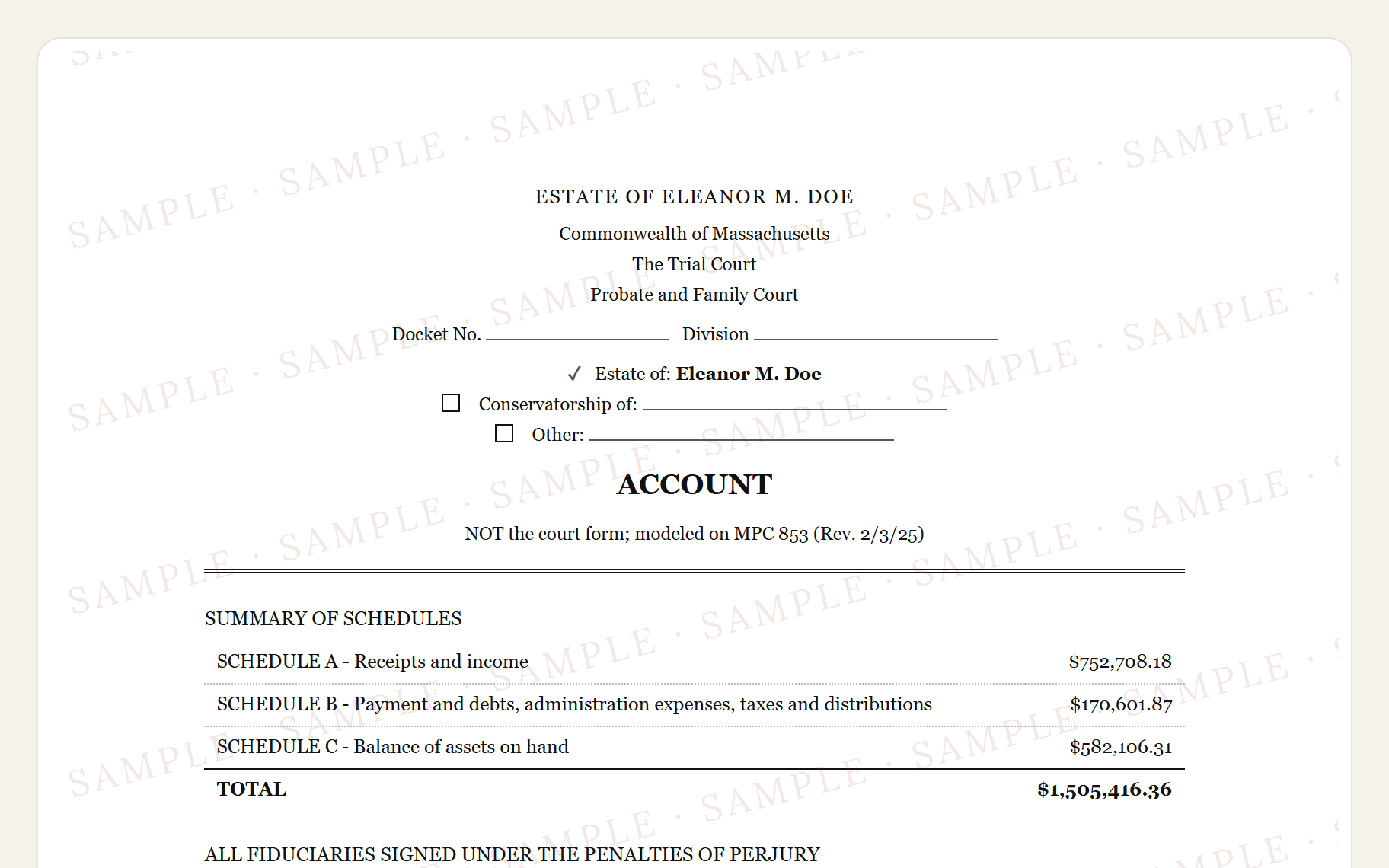
The account, form MPC 853, opens with a reporting period, from one date to another, and an account-type block: Annual Account (with an ordinal, 1st, 2nd, and so on), Final Account, Amended Account, or Other Account. Three schedules feed one total: Schedule A, Receipts and income, Schedule B, Payment of debts, administration expenses, taxes and distributions, and Schedule C, Balance of assets on hand. There is no fourth schedule for gains or losses. You swear or affirm under oath that you have read the account and that its statements are true and correct.
Filing either one with the court is voluntary for most estates. G.L. c. 190B §3-706(c) lets a personal representative satisfy the inventory duty by mailing a copy to every reasonably locatable interested person instead of filing it. A personal representative appointed under a MUPC bond is not required to file an account with the court unless the law or a court order says otherwise, though an interim or final account may always be filed voluntarily, with the filing fee. Filing the inventory becomes mandatory only alongside a Petition for License to Sell, a Petition for Allowance of Account, or a Petition for Order of Complete Settlement, or when a court orders it, or under supervised administration, or for a pre-MUPC fiduciary who still owes an annual account under the old rule.
Section 2 of 7.Massachusetts deadlines, with the statute behind each
- Day 30 (about 1 month)Publish notice of informal probate or appointment
Why
Under G.L. c. 190B, §3-306, in an informal proceeding the petitioner generally must publish notice once, in a newspaper designated by the register of probate, not more than 30 days after the informal probate or appointment; a separate written notice to heirs, devisees, and anyone with a prior or equal right to appointment typically must be delivered or mailed at least 7 days before the petition is even filed, so that piece can't be calendared from the appointment date; confirm the publication arrangements and exact deadlines with your attorney. - Day 90 (about 3 months)Inventory of estate assets due
Why
Under G.L. c. 190B, §3-706, within 3 months after appointment the personal representative generally must prepare an inventory of the decedent's property with date-of-death fair market values (and any encumbrances), and either file it with the court or mail a copy to all interested persons whose addresses are reasonably available; confirm the file-vs-mail choice and the exact deadline with your attorney. - Day 180 (about 6 months) · earliest possibleClosing statement may be filed (earliest date)
Why
Under G.L. c. 190B, §3-1003, the sworn closing statement (MPC 850) generally may not be filed earlier than 6 months after the date of original appointment of a general personal representative, and only after the creditor claim period has run, claims, expenses, and taxes are handled, the assets are distributed, and each distributee has been sent a full written account; confirm you're ready to close and the exact earliest date with your attorney.
- Day 270 (about 9 months)Massachusetts estate tax return (Form M-706), if required
Why
Under G.L. c. 65C, §6, a Massachusetts estate tax return (Form M-706) is generally due 9 months after death when the gross estate plus adjusted taxable gifts exceeds the filing threshold ($2 million for deaths on or after January 1, 2023), and the automatic 6-month filing extension typically holds only if at least 80% of the tax due is paid by the original due date; confirm whether the estate must file and the exact deadline with your attorney. - Day 270 (about 9 months)Federal estate tax return (Form 706), if required
Why
Under IRC §6075, Form 706 is due 9 months after death, but only if the gross estate exceeds the federal exemption or the estate elects portability, and a 6-month extension may be available; confirm applicability and timing with your attorney. - Day 365 (about 1 year)Creditor claims bar date
Why
Under G.L. c. 190B, §3-803, creditors generally must commence their action within 1 year after the date of death and, before that year expires, either serve the personal representative in hand (or have service accepted) or file a notice of the action with the register of probate, or the claim is barred. Calendar this date before making final distributions; confirm the operative date and any exceptions with your attorney.
The MPC 854 inventory is generally due 3 months after your appointment (G.L. c. 190B §3-706(a)). A successor personal representative gets the same 3-month window from their own appointment instead, and values the estate as of that later date rather than the date of death (§3-706(b)). If you proceed informally, notice of the probate or appointment is generally published within 30 days of it (G.L. c. 190B §3-306).
Read the full explanation
Creditor claims are generally barred 1 year after the date of death (G.L. c. 190B §3-803(a)). A Massachusetts estate tax return, Form M-706, if the estate owes one, is generally due 9 months after death (G.L. c. 65C §6), and a federal estate tax return, Form 706, runs on the same 9-month clock (IRC §6075).
A Closing Statement (MPC 850) cannot be filed earlier than 6 months after your original appointment (G.L. c. 190B §3-1003). An interim account is not allowed by the court until a full year has passed since the date of death. A final account is never allowed on its own; it is allowed only together with a Petition for Order of Complete Settlement, MPC 855 (G.L. c. 190B §3-1001).
Section 3 of 7.What Massachusetts pays a personal representative
G.L. c. 190B §3-719 sets the rule: reasonable compensation, with no statutory percentage schedule. There is no cap and no table to apply. Before qualifying, a personal representative may renounce a will's compensation clause and take reasonable compensation instead, and may renounce all or part of compensation at any time by a written renunciation filed with the court.
Section 4 of 7.How a Massachusetts estate closes
Three routes close a Massachusetts estate. A Closing Statement (MPC 850, under §3-1003) is a sworn filing, available no earlier than 6 months after your original appointment, once the creditor-claims period has run and administration is complete, with notice sent to distributees and any unpaid creditors. Once a year passes with no proceeding pending, it becomes unchallengeable except for fraud or manifest error, and your appointment automatically ends, though you are not discharged.
A Small Estate Closing Statement (MPC 851, under §3-1204) works the same way for a small estate: the same one-year unchallengeable clock, and the same automatic end to the appointment without a discharge.
The only route that discharges you and your sureties from liability is a Petition for Order of Complete Settlement (MPC 855, under §3-1001), filed together with a final account, MPC 853. That decree discharges the personal representative and any sureties from all liability under it, unless the account is later impeached for fraud or manifest error. Supervised administration can only close this way; the two closing-statement routes are not available to it.
- Wait out the 1-year creditor claims bar (G.L. c. 190B, §3-803, running from the date of death) and make sure all valid claims, taxes, and administration expenses are paid before distributing what's left.
- For the common informal route, mail each distributee a full written account of your administration, then file a sworn Closing Statement (form MPC 850) with the Probate and Family Court under G.L. c. 190B, §3-1003, no earlier than 6 months after the original appointment of a general personal representative.
- If a beneficiary, creditor, or other interested party objects, or you'd rather have the court formally sign off, file a Petition for Order of Complete Settlement (form MPC 855) under G.L. c. 190B, §3-1001 with your final account (form MPC 853) and let the Probate and Family Court allow it.
- Keep proof you mailed the account and closing statement to every distributee and known claimant. Claims against you for breach of fiduciary duty are generally barred 6 months after the closing statement is filed (§3-1005, except fraud, misrepresentation, or inadequate disclosure), and if no proceeding involving you is pending 1 year after filing, your appointment terminates (§3-1003(b)).
- For a small, simple estate, ask your attorney whether the small-estate closing statement (MPC 851, under §3-1204, for estates that fit the §3-1203 summary procedure) is available instead of the standard process.
Massachusetts handles all of this through the Probate and Family Court (filed at the county Register of Probate). There is no separate surrogate's court or orphans' court.
Section 5 of 7.The schedules explained for a first-time executor
Schedule A's first line is pre-labeled Balance of Inventory or Prior Account. On a first account, that line carries the inventory total of personal property only, following the form's own instruction, not real estate. Real estate stays off the account and lives on the inventory's Schedule of Real Estate instead, valued gross of any mortgage or lien on it.
If real estate, or anything else, is later sold, the full sale price becomes a Schedule A receipt, the same as any other money coming in. There is no separate loss line on the form: a sale's full proceeds are a receipt, and the asset leaves Schedule C at whatever value it was carried at, with no gain or loss column to fill in.
Schedule C lists what is still on hand at the end of the reporting period, with a Market Value column next to a Book Value column. In-kind distributions, property handed to a beneficiary rather than sold, print in Schedule B, naming the item and the beneficiary who received it, at carry value.
Section 6 of 7.Where ExecutorLedger fits
Recording is free for as long as the estate takes: every receipt and disbursement with date and payee, distributions per beneficiary, and a running balance that checks itself as you go. ExecutorLedger builds Massachusetts court-style documents from those records, an inventory shaped like MPC 854 and an account shaped like MPC 853, ready to transcribe onto the official forms if you end up needing to file. They are not court forms, and the estate's attorney should read them before anything is filed. Every document previews free with your real numbers, and $149 once per estate lifts the watermark.
Section 7 of 7.Questions Massachusetts executors ask
Do I have to file the Massachusetts MPC 854 inventory with the court?
Not usually. G.L. c. 190B §3-706(c) lets you satisfy the duty by mailing a copy to every reasonably locatable interested person instead of filing it. Filing becomes mandatory only alongside a Petition for License to Sell, a Petition for Allowance of Account, or a Petition for Order of Complete Settlement, or when a court orders it.
When is the Massachusetts inventory due?
Generally 3 months after your appointment (G.L. c. 190B §3-706(a)). A successor personal representative gets 3 months from their own appointment instead, and values the estate as of that later date rather than the date of death.
What is the first line of Schedule A on the MPC 853 account?
It is pre-labeled Balance of Inventory or Prior Account. On a first account it carries the inventory total of personal property only; real estate is not included there, since it stays on the inventory's own Schedule of Real Estate.
How is a Massachusetts personal representative paid?
G.L. c. 190B §3-719 sets reasonable compensation, with no statutory percentage and no fixed schedule. You may renounce a will's compensation clause before qualifying and take reasonable compensation instead.
How does a Massachusetts estate close?
Three routes: a Closing Statement (MPC 850), a Small Estate Closing Statement (MPC 851) for a small estate, or a Petition for Order of Complete Settlement (MPC 855) filed with a final account. Only the last one discharges you and your sureties from liability.
Not sure which accounting your situation calls for? Which accounting do I need? covers the choice, and the accounting guide explains the structure every format shares.
This page describes Massachusetts practice as our verified references state it; formats drift and estates differ, and none of this is legal advice. ExecutorLedger produces court-style documents for transcription. They are not official court forms. The accounting your estate needs is a question for its attorney.