Maine Estate Accounting: An Executor's Guide
Maine calls the accounting the DE-406 Probate Account, and most estates are never required to file either it or the DE-405 inventory with the court. Here is what the two statewide forms expect, and when the law requires filing one.
Section 1 of 7.The two documents: the DE-405 inventory and the DE-406 account
Maine has two statewide forms, DE-405 and DE-406, published by the Maine Association of Registers of Probate (MARP) on maineprobate.net rather than by the state's unified judicial branch. Maine's 16 probate courts are run by the counties, not by the state courts, so the forms live on maineprobate.net instead of courts.maine.gov. Rule 84(a) of the Maine Rules of Probate Procedure requires that every probate filing use the form the Maine Advisory Committee on Probate Rules promulgates, after review by the Probate Judges Assembly and MARP.
The inventory, DE-405, Probate Inventory, sorts what the decedent owned into three pre-numbered schedules: Real Property, items 1 through 6, Tangible Personal Property, items 7 through 17, and Intangible Personal Property, items 18 through 25. Every value is fair market value as of the date of death, without deductions for encumbrances, expenses, or the risk of collection. Item 26 computes a Gross Value of Inventory and, after subtracting the real property and personal property encumbrance totals, a Net Value of Inventory. One signature line, Personal Representative, with a date. No perjury clause and no notary block.
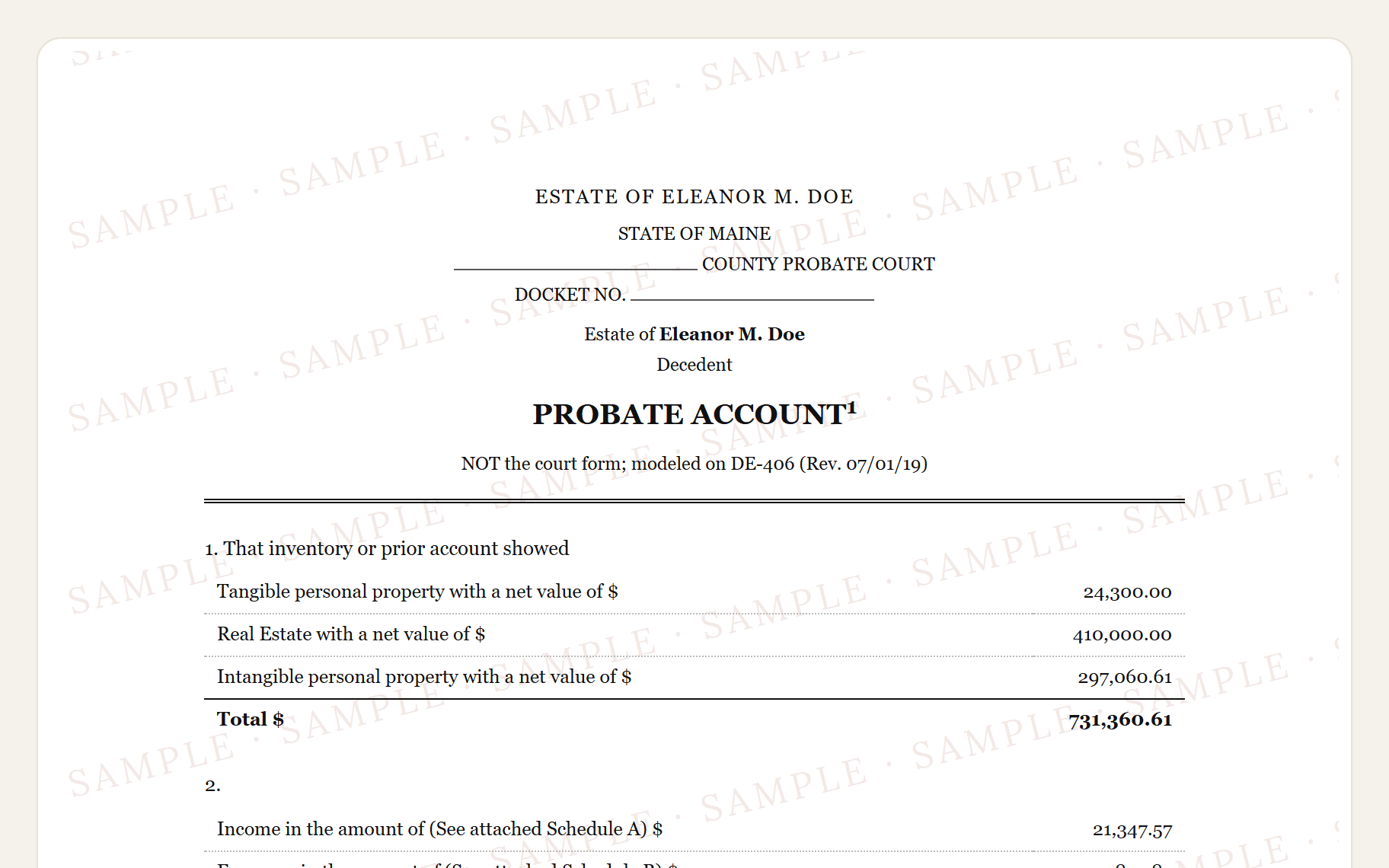
The account, DE-406, Probate Account, has no Interim, Annual, or Final checkboxes at all. Instead you fill in one open sentence, naming the kind of account and the period it covers by hand, writing in a word like first, annual, or final. It states net balances by property type at the start and end of the period, and leans on four schedules you attach for everything that happened in between: Income, Expenses, Exemptions and Allowances, and Distributions. You affirm the account under penalty of perjury, and both the Personal Representative and a Co-Personal Representative sign, if there is one.
Filing either one with the court is elective for most estates. Under 18-C M.R.S. §3-706(1), the inventory duty is satisfied by mailing a copy to interested persons who request it, or by filing it with the court, whichever route you choose. The account reaches the court only when it is attached to a DE-601 petition. Closing instead by DE-602 sworn statement requires only that you furnish a written account to the distributees, and DE-406 never has to be filed with the court on that route at all.
Section 2 of 7.Maine deadlines, with the statute behind each
- Day 14 (about 2 weeks)Publish notice to creditors
Why
Under 18-C M.R.S. §3-801, the personal representative generally must publish notice to creditors upon appointment (once a week for 2 successive weeks in a newspaper of general circulation in the county of domicile) and may also mail actual notice to known creditors; the statute's trigger is the appointment itself, so this reminder is anchored shortly after letters. Confirm publication timing and the newspaper with your attorney. - Day 30 (about 1 month)Information to heirs and devisees
Why
Under 18-C M.R.S. §3-705, the personal representative generally must give written information of the appointment (and of the court where papers are on file) to the heirs and devisees within 30 days after appointment, by delivery or ordinary mail; confirm the recipient list and timing with your attorney. - Day 90 (about 3 months)Inventory of estate property
Why
Under 18-C M.R.S. §3-706, the personal representative typically must prepare an inventory listing property with date-of-death fair market values and any encumbrances within 3 months after appointment, and either file it with the Probate Court or mail it to interested persons who request it; confirm the filing route and exact due date with your attorney. - Day 180 (about 6 months) · earliest possibleEarliest date to file informal closing statement
Why
Under 18-C M.R.S. §3-1003, an informal closing by sworn statement generally may be filed no earlier than 6 months after the original appointment of a personal representative, and only once the time for creditors' claims has expired (the statewide DE-602 form has you verify that 9 months have passed since death), so this is the first date closing becomes possible rather than a due date; confirm the estate is ready to close with your attorney.
- Day 270 (about 9 months)Creditor claims bar date
Why
Under 18-C M.R.S. §3-803, claims that arose before death are generally barred if not presented within 9 months after death, and the §3-801 notices typically bar creditors even earlier (4 months after first publication, or 60 days after mailed notice if later), so calendar this outside bar before paying claims or distributing; confirm the operative bar date for each creditor with your attorney. - Day 270 (about 9 months)Maine estate tax return (Form 706ME), if required
Why
Under 36 M.R.S. §4107, a Maine estate tax return (Form 706ME) is generally due 9 months after death, and one is required only if a federal estate tax return must be filed or the federal gross estate plus taxable gifts made within one year of death plus Maine elective property exceeds the Maine exclusion amount ($7,160,000 for deaths in 2026); Maine allows an automatic filing extension (the longer of the federal extension or 6 months) but the tax itself is still due at 9 months. Confirm whether a return is required and the payment date with your attorney. - Day 270 (about 9 months)Federal estate tax return (Form 706), if required
Why
Under IRC §6075, Form 706 is due 9 months after death, but only if the gross estate exceeds the federal exemption or the estate elects portability, and a 6-month extension may be available; confirm applicability and timing with your attorney.
The DE-405 inventory is generally due 3 months after your appointment, valued at fair market value as of the date of death (18-C M.R.S. §3-706(1)). If you later learn of property left off the inventory, or find that the original description or value was wrong, you must prepare and mail or file a supplementary inventory or appraisal (18-C M.R.S. §3-708).
Read the full explanation
Creditor claims that arose before death are generally barred nine months after the decedent's death (18-C M.R.S. §3-803(1)(A)).
An informal closing by sworn statement, DE-602, cannot be filed until both six months have passed since your original appointment and nine months have passed since the date of death, the form's own Item 1 requirement. A petition for order of complete settlement, DE-601, may be filed by the Personal Representative at any time; any other interested person must wait one year from the original appointment, and no petition is entertained until the creditor claims period has expired (18-C M.R.S. §3-1001(1)).
Once a DE-602 closing statement is filed, a claim against you is generally barred six months later, with an exception for fraud or misrepresentation (18-C M.R.S. §3-1005).
Maine sets three allowances a surviving spouse or children can claim ahead of unsecured creditors: a homestead allowance of $22,500 (18-C M.R.S. §2-402), an exempt property allowance of $15,000 for tangible personal property (18-C M.R.S. §2-403), and a family allowance with no fixed dollar figure in the statute (18-C M.R.S. §2-404).
Section 3 of 7.What Maine pays a personal representative
18-C M.R.S. §3-719 sets the rule: a personal representative is entitled to reasonable compensation for services, with no statutory percentage schedule. If a will provides for compensation and there is no contract with the decedent about it, the personal representative may renounce that provision before qualifying and take reasonable compensation instead, and may renounce all or part of compensation at any time by a written renunciation filed with the court.
Section 4 of 7.How a Maine estate closes
Maine has three routes to close an estate, all under 18-C M.R.S. Article 3, Part 10. The formal route runs through a Petition for Order of Complete Settlement, DE-601, under §3-1001. The Personal Representative may petition at any time; any other interested person must wait one year from the original appointment, and no petition is entertained until the creditor claims period has expired. After notice and a hearing, the court approves the settlement and distribution and discharges the Personal Representative. DE-601's own second checkbox, to compel the Personal Representative to file an account with the court, shows the same petition can also be used to force an accounting, not only to approve one already offered.
DE-601's title also covers §3-1002, a settlement-order track for informally probated wills, with a one-year devisee timing rule, the same creditor claims precondition as §3-1001, and dismissal if the estate turns out to be intestate. No separate form exists for that track.
The lighter route is DE-602, a Sworn Statement under §3-1003. You verify that the creditor claims period has expired, that you have fully administered the estate, providing for the homestead, exempt property, and family allowances, paying claims that were presented, administration expenses, and taxes, and distributing what is left, and that you sent a copy of the statement to every distributee and to any known claimant whose claim is neither paid nor barred. You furnish a full written account of your administration to the distributees, but you never file that account with the court on this route. If no proceeding involving you is pending in the court one year after the statement is filed, your appointment terminates automatically.
- Once the claims period has run, close informally by filing a verified sworn statement with the county Probate Court under 18-C §3-1003 (statewide Form DE-602). You can file it no earlier than 6 months after your appointment.
- Send a copy of that sworn statement to every distributee and to any known claimant whose claim is neither paid nor barred, and give each affected distributee a full written account of your administration (the DE-406 Probate Account layout works for this).
- Collect a signed receipt and release from each beneficiary as you distribute. This isn't required by statute, but it's the standard way to protect yourself.
- If anyone disputes the account or loose ends remain, petition the Probate Court for an order of complete settlement under 18-C §3-1001 (or §3-1002 after informal probate of a will) instead of closing informally.
- Expect your appointment to terminate automatically one year after the sworn statement is filed if no court proceedings involving you are pending. No separate discharge order is needed.
Probate in Maine is handled by the 16 county Probate Courts (an elected judge of probate, with a register of probate running the office), not by the state's unified trial courts. Most unsupervised estates close by the §3-1003 sworn statement; formal settlement petitions are the fallback when releases or agreement can't be had.
Section 5 of 7.The account explained for a first-time executor
Item 1 of DE-406 asks for three opening figures: tangible personal property, real estate, and intangible personal property, each at its net value, plus a total. The instruction is explicit: fill in every line, and enter 0 where there is nothing. On a first account, these figures tie back to the DE-405 inventory's own Net Value of Inventory, split across the same three property types.
Everything that happens during the period is carried by four schedules you attach yourself. DE-406 has no set layout for any of them, only a dollar line referencing each: Schedule A, Income, Schedule B, Expenses, Schedule C, Exemptions and Allowances, footnoted to the homestead, exempt property, and family allowances under 18-C M.R.S. §2-401 et seq., and Schedule D, Distributions.
Item 3, the closing balances, asks for only two figures: tangible personal property and intangible personal property, plus a total. Real estate never reappears there. If the estate still holds real property at the end of the period, its value belongs on a note beside Item 3, not folded into either closing figure.
A sale during the period moves the account by its gain or loss against the value it was carried at: a gain is an Income line, a loss an Expense line, and a sale at its carried value still gets a zero-dollar line in Income, so the record shows the sale happened.
Item 4, the Maine Estate Tax Statement, asks you to check one of four options: taxes paid, taxes not due, taxes still uncertain, or taxes certain but not yet paid. Nothing in the ledger can choose that box for you. The same goes for encumbrances: DE-405's ENCUMBRANCES, IF ANY column and DE-406's two encumbrance-subtraction lines print blank for you to fill in by hand, since the app tracks no liens.
Section 6 of 7.Where ExecutorLedger fits
Recording is free for as long as the estate takes: every receipt and disbursement with its date and description, distributions per beneficiary, and a balance that checks itself as you go. ExecutorLedger builds Maine-style documents from those records, an inventory shaped like DE-405 and an account shaped like DE-406, ready to transcribe if you end up needing to file or hand a copy to distributees. Neither is the court's own form, and your attorney should review them before anything is signed or sent. Every document previews free with your real numbers, and $149 once per estate lifts the watermark.
Section 7 of 7.Questions Maine executors ask
Do I have to file the Maine DE-405 inventory with the court?
Not always. Under 18-C M.R.S. §3-706(1), you can satisfy the duty by mailing a copy to interested persons who request it instead of filing it with the court.
When is the Maine inventory due?
Generally 3 months after your appointment, valued at fair market value as of the date of death (18-C M.R.S. §3-706(1)).
Does the DE-406 Probate Account have to be filed with the court?
Only on one of the two closing routes. Filing a Petition for Order of Complete Settlement (DE-601) attaches the account for the court to review. Closing instead by Sworn Statement (DE-602) requires only that you furnish a written account to the distributees, never to the court.
How is a Maine personal representative paid?
18-C M.R.S. §3-719 sets reasonable compensation, with no statutory percentage schedule. You may renounce a will's compensation provision before qualifying and take reasonable compensation instead.
How does a Maine estate close?
Three routes under 18-C M.R.S. Article 3, Part 10: a Petition for Order of Complete Settlement (DE-601, §3-1001), the same DE-601 form used for the §3-1002 track for informally probated wills, and a Sworn Statement (DE-602, §3-1003) once six months have passed since your appointment and nine months since the date of death.
Not sure which accounting your situation calls for? Which accounting do I need? covers the choice, and the accounting guide explains the structure every format shares.
This page describes Maine practice as our verified references state it; formats drift and estates differ, and none of this is legal advice. ExecutorLedger produces court-style documents for transcription. They are not official court forms. The accounting your estate needs is a question for its attorney.